Few things are as closely connected to everyday American life as the automobile.
Cars and trucks have influenced how Americans travel, work, live, and spend their free time. They have also become part of American popular culture, from classic cars and muscle cars to pickup trucks, lowriders, road-trip vehicles, and modern electric cars.
The American automobile story is especially interesting because there is no single type of vehicle that represents the entire country. A family in Texas may rely on a large pickup truck, a commuter in California may drive an electric vehicle, while a classic-car enthusiast in another state may spend weekends restoring a vehicle from decades ago.
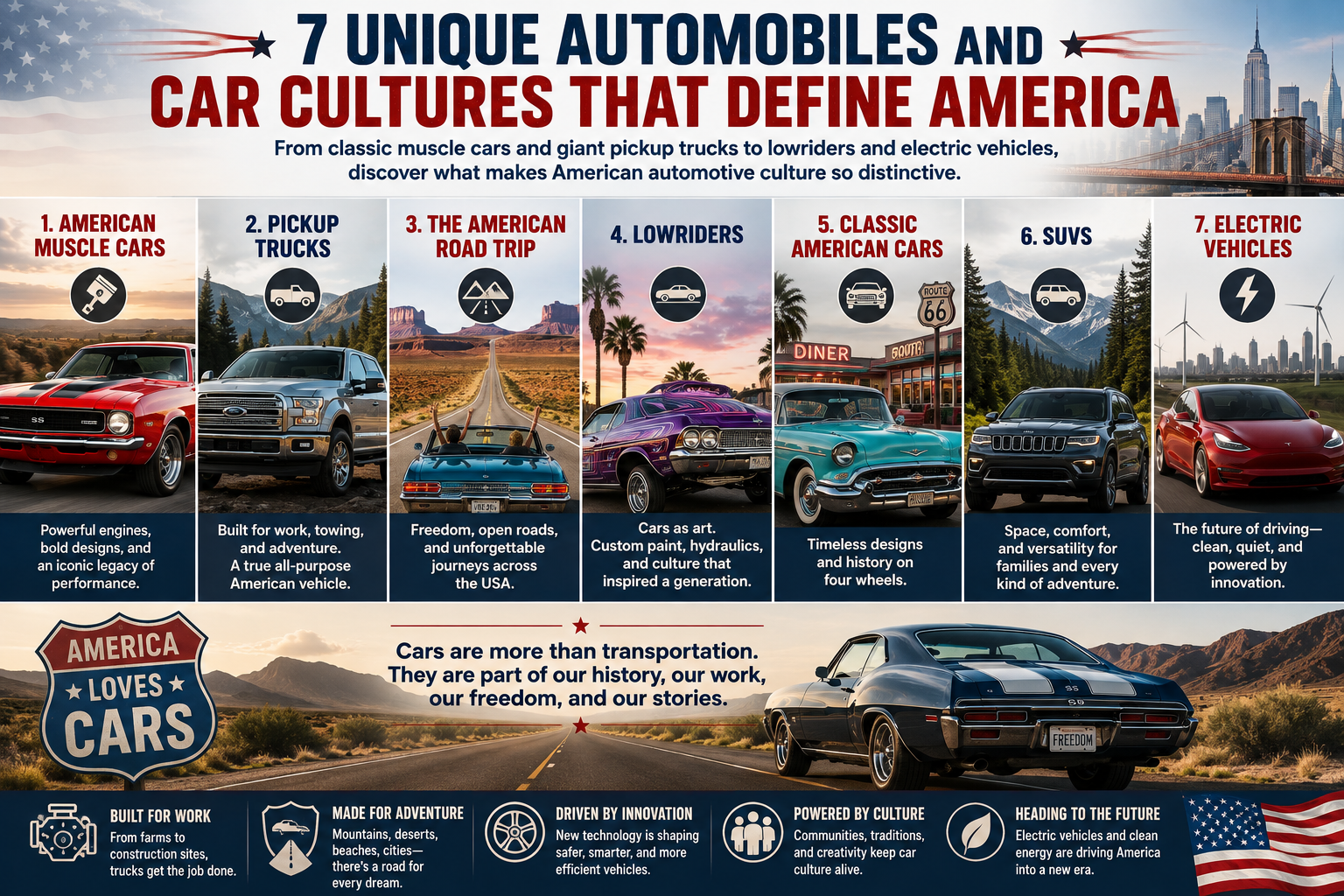
Here are seven unique automobile styles and traditions that help explain America's relationship with cars.
1. American Muscle Cars: Performance With Personality
Muscle cars became one of the most recognizable parts of American automotive culture.
These cars traditionally combined relatively powerful engines with performance-oriented designs, creating vehicles that were built to deliver an exciting driving experience.
Names such as the Ford Mustang, Chevrolet Camaro, and Dodge Challenger became closely associated with American performance-car culture.
Muscle cars are also connected to a particular period of American automotive history. Their designs, engine sounds, colors, and proportions became cultural symbols that continue to influence modern vehicles.
Today, performance cars can use technologies that were unimaginable during the classic muscle-car era, including sophisticated electronic systems, advanced transmissions, hybrid powertrains, and electric propulsion.
2. Pickup Trucks: America's Work-and-Life Vehicle
Pickup trucks occupy a special position in the American automobile market.
For many owners, a truck is more than transportation. It can be a work vehicle, towing machine, family vehicle, travel companion, or weekend adventure tool.
Modern pickups are available in many configurations, from smaller lifestyle-oriented trucks to heavy-duty models designed for demanding work.
The popularity of pickup trucks also reflects the size and diversity of the United States. Rural communities, construction workers, farmers, outdoor enthusiasts, and people who simply prefer the space and capability of a truck can all have different reasons for choosing one.
The pickup has therefore evolved beyond its original work-focused identity and become part of everyday American life.
3. The American Road Trip
Perhaps the most uniquely American automobile experience is the long-distance road trip.
The United States has an enormous network of highways and roads connecting cities, small towns, national parks, beaches, deserts, mountains, and rural communities.
That geography helped create a culture in which the journey itself can be part of the experience.
A road trip might involve driving along the Pacific Coast, crossing the Southwest, exploring the Great Plains, traveling through the Rocky Mountains, or visiting small towns far from major cities.
The vehicle becomes part of the adventure. Space for luggage, comfortable seats, reliable navigation, entertainment systems, and good fuel or charging options can all become important during a long journey.
4. Lowriders: Cars as Rolling Art
Lowriders represent one of the most visually distinctive automobile cultures in the United States.
Rather than focusing only on factory specifications, lowrider culture can turn a vehicle into a highly personalized work of art.
Custom paint, detailed interiors, polished wheels, lowered suspension, and other modifications can completely transform the appearance of a car.
The tradition is particularly associated with communities in the American West and Southwest and has developed into an important part of American automotive and cultural history.
Houston, for example, has its own distinctive custom-car tradition. The Library of Congress has documented the local “slab” car culture, in which customized older vehicles became an important form of automotive expression. :contentReference[oaicite:1]{index=1}
5. Classic American Cars: History on Four Wheels
Classic cars provide another way to experience American automotive history.
Vehicles from earlier decades can reveal how American ideas about design, technology, comfort, and transportation changed over time.
Collectors and enthusiasts often restore classic vehicles while trying to preserve original details. Others customize them with modern engines, brakes, suspension, electronics, and interior equipment.
Car museums, shows, auctions, and enthusiast events provide places where these vehicles can be displayed and appreciated.
The Library of Congress maintains extensive automotive collections, including photographs and historical materials documenting classic cars, racing, and American automobile culture. :contentReference[oaicite:2]{index=2}
6. SUVs: From Utility to Everyday Transportation
Sport utility vehicles have become a major part of the modern American automotive landscape.
An SUV can combine passenger space with cargo capacity and, depending on the model, features intended for towing, off-road driving, winter conditions, or long-distance travel.
Modern SUVs range from small urban crossovers to large three-row vehicles and specialized off-road models.
The popularity of SUVs has also influenced the development of electric vehicles. The U.S. Department of Energy reported that SUVs represented more than half of U.S. battery-electric and plug-in hybrid sales in 2023, illustrating how electrification is increasingly appearing in larger vehicle categories. :contentReference[oaicite:3]{index=3}
7. American Electric Vehicles: A New Chapter
The American automotive landscape is changing as electric vehicles become part of the mainstream vehicle conversation.
Electric vehicles replace traditional gasoline engines with electric motors and battery systems. They can offer a different driving experience, including quiet operation and immediate motor response.
Electric vehicles are now available in several vehicle categories, including sedans, crossovers, SUVs, pickup trucks, and performance-oriented models.
The transition is not simply about replacing gasoline with electricity. It also involves charging infrastructure, battery technology, software, vehicle manufacturing, and changes in how drivers think about refueling.
The U.S. Department of Energy's electric-drive roadmap projects continued growth in battery-electric and plug-in hybrid vehicle sales through the end of the decade, although projections are not guarantees of future market outcomes. :contentReference[oaicite:4]{index=4}
Why Are American Automobiles So Diverse?
The United States is geographically enormous, and driving conditions can vary dramatically.
A vehicle used in a snowy northern state may need different capabilities from one used in a desert region. Someone living in a dense city may prioritize compact dimensions and parking convenience, while someone in a rural community may value towing capacity and cargo space.
Culture also matters.
Cars can represent work, independence, recreation, family life, engineering, artistic expression, or personal identity. That is one reason American automotive culture has produced so many different vehicle traditions.
American Automobiles at a Glance
| Automobile Style | What Makes It Interesting | Common Use or Culture |
|---|---|---|
| Muscle Cars | Performance-focused design and powerful engines | Car enthusiasts and performance culture |
| Pickup Trucks | Combination of passenger space and cargo capability | Work, towing, recreation and everyday driving |
| Road-Trip Vehicles | Comfort, storage and long-distance capability | Travel and exploring the USA |
| Lowriders | Highly customized appearance and artistic expression | Community and custom-car culture |
| Classic Cars | Historical designs and collectible appeal | Restoration, museums and car shows |
| SUVs | Passenger space and versatile utility | Families, travel and outdoor activities |
| Electric Vehicles | Electric propulsion and advanced technology | Modern transportation and evolving automotive technology |
Cars Are More Than Transportation
One reason automobiles remain so interesting in the United States is that they can represent much more than transportation.
A pickup truck can represent someone's profession. A classic car can preserve a piece of history. A lowrider can represent artistic creativity and community. A sports car can represent a passion for engineering and performance. An electric vehicle can represent an interest in new transportation technology.
Even an ordinary family SUV can become part of someone's personal story through road trips, vacations, daily commutes, and family memories.
The Future of American Automobiles
The American automobile industry continues to change through electrification, software, driver-assistance technologies, new manufacturing methods, and changing consumer preferences.
At the same time, older automotive traditions have not disappeared. Classic-car shows, restoration projects, racing events, custom vehicles, and enthusiast communities continue to keep earlier automotive styles visible.
This creates an unusual combination: the future of American transportation is becoming increasingly digital and electric, while the country's automotive past remains highly visible on roads, at museums, and at car events.
Final Thoughts
There is no single automobile that represents America.
Instead, American automotive culture is a collection of different vehicles and traditions shaped by geography, work, technology, history, and personal expression.
From a classic muscle car on a weekend cruise to a pickup truck working on a farm, a lowrider displayed at a community event, or an electric SUV traveling across the country, each vehicle can tell a different American story.
The most unique thing about American automobiles may not be the cars themselves, but the stories people build around them.
Vehicle specifications, availability, prices, regulations, and technology can change over time. Always check the manufacturer's current information and applicable state and federal requirements before purchasing or modifying a vehicle.
No comments yet. Be the first to share your thoughts!