Deals & Reviews
A Unique Guide to Finding Better Value
Discover practical ways to find worthwhile deals, evaluate product reviews, compare prices, and make smarter purchasing decisions across the USA.
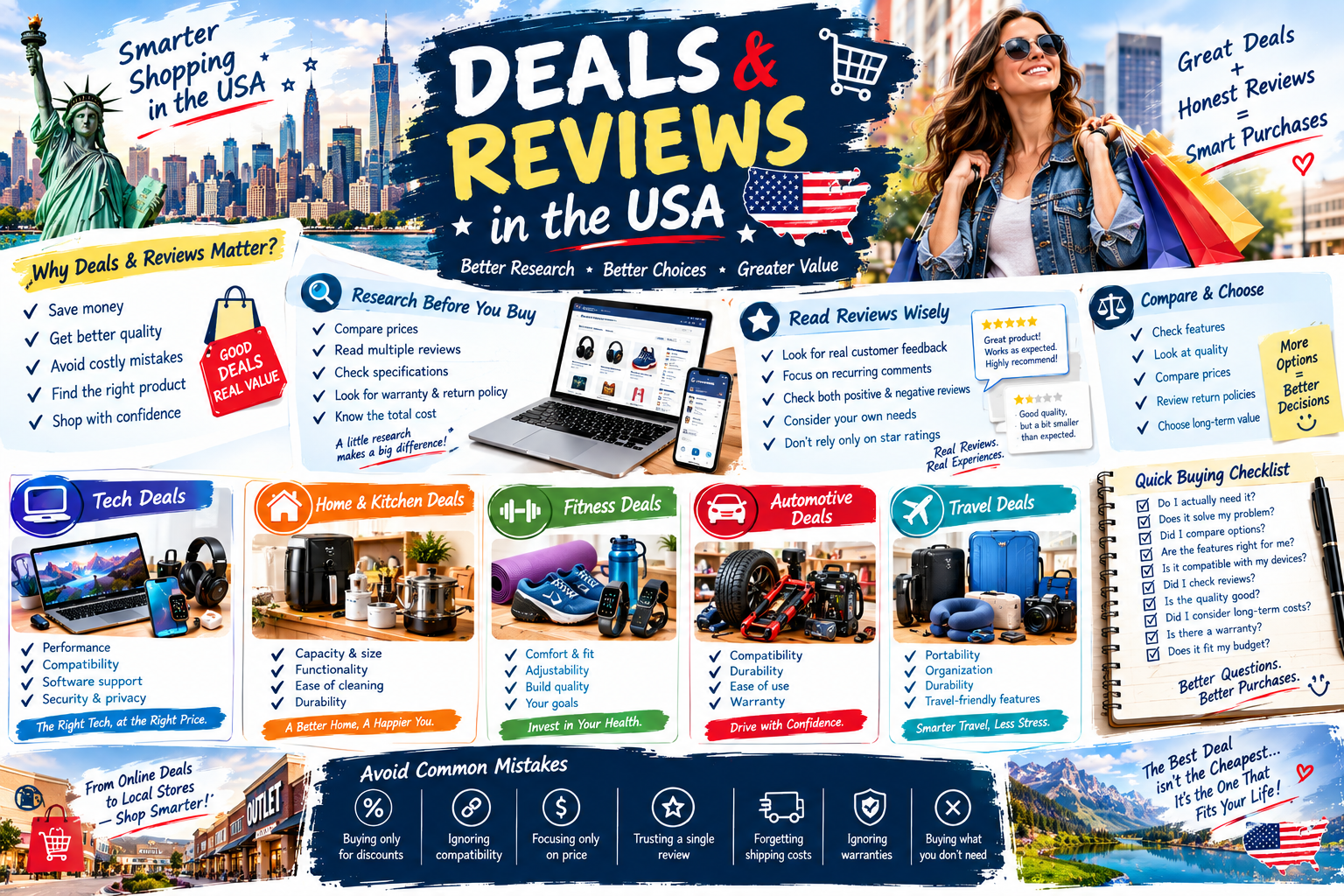
Shopping in the USA can provide access to an enormous range of products, retailers, promotions, and online marketplaces. With so many choices available, shoppers may see discounts and reviews everywhere they look.
But a lower price does not automatically mean a better deal.
A worthwhile deal combines useful features, appropriate quality, fair pricing, reliability, and suitability for your needs. Reviews can then provide additional insight into how a product performs in real-world situations.
The smartest approach is to consider the complete value of a purchase, rather than focusing on a discount percentage alone.
1. Look Beyond the Discount
A product advertised as “on sale” still needs to be evaluated carefully.
Before purchasing, consider:
The current selling price
Prices of similar products
Important features
Product quality
Expected durability
Warranty and return policies
Additional accessories or costs
Whether you actually need the product
A 30% discount on something you do not need is not necessarily a good deal. A fairly priced product that solves an important problem may provide much greater value.
2. Compare Prices Before Buying
Price comparison is one of the simplest ways to shop more intelligently.
Instead of immediately purchasing the first discounted product you see, compare several similar options. Look at the features and overall value alongside the price.
A useful comparison might include:
Factor Product A Product B Product C
Price Compare Compare Compare
Key features Review Review Review
Quality Evaluate Evaluate Evaluate
Customer feedback Check Check Check
Warranty Check Check Check
Return policy Check Check Check
Overall value Consider Consider Consider
This helps prevent a shopper from confusing a visible promotion with the best available choice.
3. Learn How to Read Reviews
Reviews can be extremely useful, but they should not be judged by star ratings alone.
Look for recurring themes across multiple reviews.
Pay attention to comments about:
Product quality
Reliability
Ease of use
Durability
Setup
Performance
Customer service
Common problems
Whether the product matches its description
A single negative review may describe an unusual experience. However, repeated complaints about the same issue may reveal something worth investigating.
4. Consider Both Positive and Negative Feedback
Reading only five-star reviews can create an incomplete picture.
Positive reviews can reveal what customers appreciate, while negative reviews may highlight limitations or potential problems.
Ask:
“Are the reported disadvantages important for the way I plan to use this product?”
A limitation that matters to one shopper may be completely unimportant to another.
5. Understand Price vs. Value
Price tells you what you pay. Value tells you what you receive in return.
A product with a higher price can sometimes offer better long-term value because it provides features, quality, convenience, or durability that genuinely matter to the buyer.
At the same time, paying more does not automatically guarantee better quality.
The better question is:
“Does this product provide enough useful value for what I am paying?”
6. Check the Details Behind a Deal
Before purchasing a promoted product, review the available information carefully.
Check:
Product specifications
Included accessories
Size or capacity
Compatibility
Warranty information
Return conditions
Shipping costs
Any recurring expenses
Seller information
Understanding the complete offer can help prevent unpleasant surprises after checkout.
7. Deals and Reviews for Technology
Technology products often receive frequent promotions and upgrades.
When evaluating smartphones, laptops, accessories, smart-home devices, gaming equipment, or other electronics, consider whether the product actually fits your needs.
Think about:
Performance
Compatibility
Connectivity
Software support
Ease of use
Durability
Privacy and security
Long-term usefulness
The newest device is not necessarily the best deal if an older model already provides everything you need.
8. Deals for Home and Kitchen Products
Home and kitchen products can vary significantly in quality and usefulness.
When considering appliances, cookware, storage products, cleaning equipment, or household essentials, look beyond the promotional price.
Consider:
Available space
Frequency of use
Capacity
Cleaning requirements
Construction quality
Practical features
Warranty and returns
A product that fits your home and routine can provide more value than one with a larger discount but limited usefulness.
9. Fitness and Lifestyle Deals
Fitness products can range from simple accessories to larger pieces of equipment.
Before buying, determine whether the product matches your workout goals and routine.
Reviews may be particularly useful for understanding comfort, ease of use, construction, and everyday practicality.
Avoid purchasing fitness products simply because they are heavily discounted. A product that remains unused provides little value regardless of its original price.
10. Automotive Deals and Tools
Automotive tools and accessories should be selected carefully.
Compatibility and intended use are particularly important. Before purchasing, make sure the product is appropriate for the specific task and vehicle where applicable.
Reviews can help identify practical experiences involving usability, durability, setup, or limitations.
For safety-critical work, follow the vehicle or equipment manufacturer's instructions and use appropriate professional assistance when necessary.
11. Travel Deals
Travel-related deals can include luggage, organizers, accessories, electronics, outdoor equipment, and other travel essentials.
When comparing products, consider:
Portability
Size
Organization
Durability
Ease of use
Compatibility with your travel needs
Long-term usefulness
The cheapest travel product may not be the best choice if it is inconvenient or unsuitable for repeated use.
12. Be Careful With “Limited-Time” Pressure
Some promotions create urgency by emphasizing that an offer may disappear soon.
While genuine limited-time offers exist, shoppers should avoid allowing urgency to replace research.
Before clicking “buy,” ask:
“Would I purchase this product at the same price if I had time to think about it?”
If the answer is no, taking a pause may be worthwhile.
13. Watch for the Total Purchase Cost
The advertised product price may not represent the complete cost.
Depending on the purchase, additional expenses could include:
Shipping
Accessories
Installation
Maintenance
Replacement parts
Consumables
Subscriptions
Upgrades
Comparing total costs gives you a more accurate picture of the deal.
14. How to Identify Useful Review Patterns
A practical review-reading strategy is to look for three things:
Consistent Strengths
If many customers independently praise the same characteristic, it may be an important advantage.
Consistent Weaknesses
Repeated complaints deserve attention, especially when they relate directly to your intended use.
Differences in Expectations
Some negative reviews may result from customers expecting something the product was never designed to provide.
Understanding the context behind reviews is more useful than simply counting stars.
15. Don't Let Reviews Make the Decision for You
Reviews are evidence, not instructions.
A highly rated product can still be wrong for your particular situation. Likewise, a product with some negative feedback may still be appropriate if the complaints concern features you do not care about.
Use reviews to answer questions such as:
Does it work as expected?
Is it easy to use?
Does it appear durable?
Are there recurring problems?
Does it fit my needs?
Then make the final decision based on your own requirements.
16. Common Deals and Reviews Mistakes
Shoppers often make avoidable mistakes, including:
Buying because of a large discount percentage
Looking only at the lowest price
Reading only positive reviews
Ignoring negative review patterns
Forgetting shipping or additional costs
Assuming expensive means better
Ignoring compatibility
Overlooking warranty information
Buying products they do not actually need
Making decisions under artificial urgency
A few minutes of careful research can often prevent these mistakes.
17. A Smarter Shopping Strategy
A simple five-step process can make deal hunting easier:
Step 1: Identify the need.
Know exactly what you are trying to purchase and why.
Step 2: Find several options.
Do not limit your research to the first product you discover.
Step 3: Compare value.
Look at price, features, quality, reviews, and long-term usefulness.
Step 4: Check the details.
Review compatibility, warranty, returns, shipping, and other conditions.
Step 5: Decide without pressure.
If the product genuinely fits your needs and offers reasonable value, then consider purchasing.
18. Deals Should Support Smarter Shopping
A good deal should make a useful purchase more affordable—not convince you to purchase something unnecessary.
The best shoppers understand the difference between:
“This is discounted.”
and
“This is valuable to me at this price.”
That difference is at the heart of smarter shopping.
Final Thoughts
Deals and reviews can make shopping in the USA more informed and convenient, but they work best when combined with careful research.
A strong purchasing decision considers need, price, quality, features, reviews, compatibility, total cost, warranty, and long-term value.
Instead of chasing every promotion, focus on finding products that genuinely fit your lifestyle and budget.
The best deal is not simply the biggest discount—it is the purchase that gives you the right value for your money.
🛒 View Product Details: lock for drawer
🛒 View Product Details: 2?in?1 Bikini Trimmer for Women
🛒 View Product Details: Wireless Trailer Lights Magnetic
As an Amazon Associate we earn from qualifying purchases made through these links, at no extra cost to you.
Advertisement
No comments yet. Be the first to share your thoughts!